Friday, August 25, 2006

Oh for crying out loud!

I received news today that my blood tests came back okay - with one abnormality. My cholesterol level wasn't normal. Acceptable levels for cholesterol fall within the 140-199 range.

Mine was 128!

I was dancing a jig, planning to eat a pound of bacon dipped in butter when I came across an article about the risks of low cholesterol. THE RISKS OF LOW CHOLESTEROL!!! Isn't that like writing about the risks of using seat belts, or the danger in looking both ways, or the hazards of not running with scissors?

As it turns out, researchers have linked very low cholesterol - that's what I've got - with increased risk of depression anxiety and something called hemorrhagic stroke. Great. I finally get my HDL and LDL under control only to find I might get freaked out, bummed out or stroked out!

Health isn't everything its cracked up to be . . .

Friday, August 18, 2006

Wednesday, August 16, 2006

PAPA Prayer

I'm reading Larry Crabb's book The PAPA Prayer. Here is a great excerpt from it:

Petitioning without relationship - that's what our praying so often amounts to, even though it's well disguised. No matter how piously we couch our requests and no matter how passionately we declare our confidence in the Giver's generosity, we stay in receiving mode. "Gimme! Gimme! Gimme!" It's all about us.

Our prayers of communion and worship sometimes have more to do with staying on God's good side in order to get more blessings than with building our relationship with Him. The idea of knowing God and being known by Him just doesn't seem that important.

For some, it's irrelevant. Children during a long, hot summer may know the ice cream man's name and may even greet him warmly and enjoy his smile, but the point is the ice cream. When my grandkids sit on Santa's lap in the mall, they have yet to ask Santa how he's doing, if maybe he's getting a little tired of all these kids. They hop on his lap, recite their list of desired gifts, and hop off. We Christians call it prayer.

Thursday, August 10, 2006

Why I am Faith Only

“If you would like to receive Christ into your life, just pray this prayer with me, and you will be saved,” intoned the speaker at our state-wide youth convention. I knew right away that there would be trouble. Sure enough, before the “amen” was spoken, I was confronted by an angry minister. “What is he doing?” demanded my friend. “It sounds to me like he is leading them in the sinner’s prayer,” I responded. It was not my first encounter with those who hold a “faith only” position for salvation, and it has not been my last.

Fact is, I’ve become faith only, too. No, I haven’t decided repentance is unnecessary, that confessing faith in Christ is superfluous, or that baptism is merely an “outward expression of an inward grace.” What has changed is my understanding of the word “faith,” and what it means. Still, it’s easy to see why there is such disagreement between our fellowship of churches and denominations over this issue. After all, faith only has been the predominant protestant position since the sixteenth century.

“Faith only” as Luther saw it
In his tower office in Wittenburg, Martin Luther read Romans 1:17, “The righteous will live by faith.” From that text, Luther developed his sola fide doctrine (Latin for “faith alone”). As a monk, Luther had witnessed first-hand the attempts at faithful Catholics to be justified by good works. Attending mass, reciting prayers, making pilgrimage to Rome, and even purchasing “indulgences” which promised forgiveness of sins in exchange for money were all means of obtaining righteousness in Luther’s day. Luther came to believe that many of these practices were not merely unnecessary but were abuses of power by the church. Luther determined that scripture – not the Pope – would be his sole authority in matters of faith and practice. These two beliefs, sola fide and sola scriptura, became Luther’s legacy and the defining doctrines of the Protestant Reformation.
1 Our convention speaker’s prayer was evidence of Luther’s enduring influence.

Faith defined
A website for a translation services company details some of the funny mistakes that well-meaning translators sometimes make. A sign in a Scandinavian airport reads, “We’ll take your bags and send them in all directions.” This sign hangs in a Hong Kong dentist’s office: "Teeth extracted by latest methodists."2


When translating from one language to another, some of the original meaning can be lost. Such is the case with the Greek words that are translated as “faith.” Pisteuo (pronounced pis-tyoo-oh), and its root word, pistis, are translated predominately two ways in most modern translations – as “belief” and “faith.” But like many English words, “belief” and “faith” are somewhat inadequate translations for pisteuo and pistis.

According to Kittel’s Theological Dictionary of the New Testament, pisteuo carries with it more than one connotation. It can mean a) to believe; b) to obey; c) to trust; d) to hope and e) as faithfulness.3
Faith, as understood by Paul’s readers, was (and is) a multi-faceted concept.

Faith is belief
“Faith is about believing certain things are true. . .,” writes the British apologist Alister McGrath. When a person says, “I believe in God,” often what they mean is something like, “I believe there is a God.” In that sense, faith is a mental affirmation or cognitive assent to a fact or set of facts.4
Affirming my belief in God is somewhat akin to saying “I believe in George Washington.” Although I have no first-hand knowledge that he lived, based on the evidence presented me by my first grade teacher, Mrs. Parks, I believe that the father of our country existed.

Sadly, this is as far as some people ever come. They mistakenly believe that an acknowledgement that God exists is a faith that is sufficient to save. James 2:19 shows the folly of that sort of “faith.” “You believe that there is one God. Good! Even the demons believe that--and shudder.” Obviously, merely assenting that God exists isn’t enough, for if it were, demons would be saved. There must be something more to faith.

Faith is trust
Fifteen years ago, my wife and I vowed to each other that we would love, honor and cherish one another until parted by death. We accepted each other’s promises; we put our faith in one another. We trusted each other.

Trust is the second facet of faith. Merely believing God exists is not enough. We must also trust that He is able to do that which He says He can do. Both Paul and Peter quote the prophet Isaiah: "See, I lay in Zion a stone that causes men to stumble and a rock that makes them fall, and the one who trusts in him will never be put to shame."5 Trust is part and parcel to faith. Many believe that God exists, but, for whatever reason, they are unable to trust Him. Maybe their trust has been violated by a parent or a spouse. Maybe someone in authority abused their trust, and although they believe God exists, they never manage to trust Him. Without trust, there is no faith. But is trust enough? While many say, “yes,” scripture indicates that faith has a third facet.

Faith is response
Faith is also response. “Trust and obey,” sings the old hymn, and rightly so. In his commentary on the book of Acts, Gareth Reese points out five reasons why faith requires obedience. Most of them require an understanding of Greek grammar. Suffice it to say that the original Greek supports the idea, and that in several scripture passages, belief and obedience are synonymous. Reese writes: “There are at least two places in the New Testament where ‘belief’ and ‘disobedience’ are contrasted, and these show convincingly that the faith that saves includes obedience as one of its constituent elements.”6


Belief alone is not enough. Demons believe, but are not saved. Trust is not enough. Trust is necessary, but without action, it cannot save. Only faith which includes belief, trust and an obedient response is sufficient to save.

McGrath uses a medical analogy to explain the nature of saving faith. Imagine that I am suffering from deadly blood poisoning, and that the cure, a bottle of penicillin is available to me. I have three options. First, I can believe that the bottle of penicillin exists. This requires no great leap. After all, seeing is believing, and I am looking at the bottle of pills. Second, I may trust that the medicine is sufficient to cure my illness, which would quite probably kill me otherwise. But, third, unless I respond by taking the medicine, I will die, “believing and trusting, but having failed to benefit at all from the resource which could have saved me.”

Faith requires a response, or it is not faith. If my denominational brothers and I can agree on this principle, then the gap in our doctrine becomes much more narrow and focused. Instead of debating what is or what is not necessary for salvation, the debate shifts to “what is the biblical response?”. Is it praying the sinner’s prayer? Is it raising a hand or coming forward during the altar call? Is it signing a commitment card? These are all responses and are acts of faith. Yet none of them are found in scripture. The only scriptural response that accompanies belief and trust is repentance, confession and baptism. That is the response saving faith requires.

Yes, I am faith only – if we are talking about the faith that is believing, trusting and responding. Given that definition of faith, I suspect I am not alone.

[1]Earle E. Cairns, Christianity Through the Centuries: A History of the Christian Church (Grand Rapids: The Zondervan Corporation, 1954-1981) pp. 289-290.
[2]http://www.transperfect.com/tp/eng/badxlate.html
[3]G. Friedrich, Theological Dictionary of the New Testament (Grand Rapids: Eerdmans, 1968), 6:174-175.
[4]Alister E. McGrath, Intellectuals Don’t Need God and Other Myths (Grand Rapids: Zondervan Publishing House, 1993), pp. 48-52.
[5]Romans 9:33 & 1 Peter 2:6.
[6]Gareth L. Reese, New Testament History: A Critical and Exegetical Commentary on the Book of Acts (Joplin, Missouri: College Press Publishing Company, 1976): pp. 604-605.

Wednesday, August 09, 2006

Better Panda than Person

The Chinese People's Daily newspaper recently reported that 12 year-old Panda Ying-Yang gave birth to twins. This is her fourth pregnancy, all resulting in twin deliveries. For those of you who struggle with math, that is 8, e-i-g-h-t babies.

Apparently you're better off being a Panda in China. Humans are restricted to only one pregnancy. Those who become pregnant a second time are forced to have an abortion. If they somehow avoid the population police, they can lose their home, job, and liberty. Does this strike anyone else as amazingly absurd?

It's about as absurd as a country legally protecting bald eagle nests and eggs, but allowing otherwise healthy human babies to be aborted. Oh wait . . . that's us, isn't it.

Tuesday, August 08, 2006

Larry not Dennis

I received this email today. It was incorrectly attributed to Dennis Miller, of Saturday Night Live fame. Actually, it was written by columnist Larry Miller. I'm not surprised that Dennis didn't write it. I am amazed at how clearly it elucidates the conflict in the Middle East.

A brief overview of the situation is always valuable, so as a service to all Americans who still don't get it, I now offer you the story of the Middle East in just a few paragraphs, which is all you really need. Don't thank me. I'm a giver. Here we go:

The Palestinians want their own country. There's just one thing about that: There are no Palestinians. It's a made up word. Israel was called Palestine for two thousand years. Like "Wiccan," "Palestinian" sounds ancient but is really a modern invention. Before the Israelis won the land in war, Gaza was owned by Egypt, and there were no "Palestinians" then, and the West Bank was owned by Jordan, and there were no "Palestinians" then. As soon as the Jews took over and started growing oranges as big as basketballs, what do you know, say hello to the "Palestinians," weeping for their deep bond with their lost "land" and "nation." So for the sake of honesty, let's not use the word "Palestinian" any more to describe these delightful folks, who dance for joy at our deaths until someone points out they're being taped. Instead, let's call them what they are: "Other Arabs Who Can't Accomplish Anything In Life And Would Rather Wrap Themselves In The Seductive Melodrama Of Eternal Struggle And Death." I know that's a bit unwieldy to expect to see on CNN. How about this, then: "Adjacent Jew-Haters."

Okay, so the Adjacent Jew-Haters want their own country. Oops, just one more thing. No, they don't. They could've had their own country any time in the last thirty years, especially two years ago at Camp David. But if you have your own country, you have to have traffic lights and garbage trucks and Chambers of Commerce, and, worse, you actually have to figure out some way to make a living. That's no fun. No, they want what all the other Jew-Haters in the region want: Israel. They also want a big pile of dead Jews, of course-that's where the real fun is-but mostly they want Israel. Why? For one thing, trying to destroy Israel — or "The Zionist Entity" as their textbooks call it — for the last fifty years has allowed the rulers of Arab countries to divert the attention of their own people away from the fact that they're the blue-ribbon most illiterate, poorest, and tribally backward on G-d's Earth, and if you've ever been around G-d's Earth, you know that's really saying something. It makes me roll my eyes every time one of our pundits waxes poetic about the great history and culture of the Muslim Mideast. Unless I'm missing something, the Arabs haven't given anything to the world since Algebra, and, by the way, thanks a hell of a lot for that one.

Chew this around and spit it out: Five hundred million Arabs; five million Jews. Think of all the Arab countries as a football field, and Israel as a pack of matches sitting in the middle of it. And now these same folks swear that if Israel gives them half of that pack of matches, everyone will be pals. Really? Wow, what neat news. Hey, but what about the string of wars to obliterate the tiny country and the constant din of rabid blood oaths to drive every Jew into the sea? Oh, that? We were just kidding.

My friend Kevin Rooney made a gorgeous point the other day: Just reverse the numbers. Imagine five hundred million Jews and five million Arabs. I was stunned at the simple brilliance of it. Can anyone picture the Jews strapping belts of razor blades and dynamite to themselves? Of course not. Or marshalling every fiber and force at their disposal for generations to drive a tiny Arab state into the sea? Nonsense. Or dancing for joy at the murder of innocents? Impossible. Or spreading and believing horrible lies about the Arabs baking their bread with the blood of children? Disgusting. No, as you know, left to themselves in a world of peace, the worst Jews would ever do to people is debate them to death.

Mr. Bush, G-d bless him, is walking a tightrope. I understand that with vital operations coming up against Iraq and others, it's in our interest, as Americans, to try to stabilize our Arab allies as much as possible, and, after all, that can't be much harder than stabilizing a roomful of supermodels who've just had their drugs taken away. However, in any big-picture strategy, there's always a danger of losing moral weight. We've already lost some. After September 11 our president told us and the world he was going to root out all terrorists and the countries that supported them. Beautiful. Then the Israelis, after months and months of having the equivalent of an Oklahoma City every week (and then every day) start to do the same thing we did, and we tell them to show restraint. If America were being attacked with an Oklahoma City every day, we would all very shortly be screaming for the administration to just be done with it and kill everything south of the Mediterranean and east of the Jordan. (Hey, wait a minute, that's actually not such a bad id ... uh, that is, what a horrible thought, yeah, horrible.)

Saturday, July 29, 2006

Barclay on Baptism

Back in college, I recall one particular professor who decried William Barclay as a churchman who did not believe in the miracles of the New Testament. My reading of the enigmatic Barclay bears that opinion out. Nevertheless, I read something in Barclay's commentary on Colossians that sounds like it was written by Alexander Campbell. Here it is:

Baptism in the time of Paul was three things. It was adult baptism; it was instructed baptism; and, wherever possible, it was baptism by total immersion. [author's emphasis] Therefore the symbolism of baptism was manifest. As the waters closed over the man's head, it was as if he died; as he rose up again from the water, it was as if he rose to new life. Part of him was dead and gone for ever; he was a new man risen to a new life.

But, it must be noted, that symbolism could become a reality only under one condition. It could become real only when a man believed intensely in the life and death and resurrection of Jesus Christ. It could only happen when a man believed in the effective working of God which had raised Jesus Christ from the dead and could do the same for him. Baptism for the Christian was in truth a dying and a rising again, because he believed that Christ had died and risen again and that he was sharing in the experience of his Lord.

You go, Bill!

William Barclay, The Daily Study Bible Series: The Letters to the Philippians, Colossians, and Thessalonians, Revised edition, (Philadelphia, The Westminster Press, 1975), p. 140.

Northmen Sing!

My sons and I leave for our annual Northmen camping trip tomorrow. Part business, part pleasure, this trip is a great opportunity to connect with my sons, with ministry colleagues, and with great preaching. I'm especially looking forward to hearing Mark Scott preach. That guys always has something to say and a great way to say it.

My sons enjoy the event because they're out in the woods where they can "fart, scratch, and burp without mom yelling at them." Okay, okay, I admit it. That part of the trip doesn't bother me too much either.

Oh Be Careful Little Tongue What You Preach

Sunday morning, during a sermon on the power of the tongue and the care that must be taken to control it, I preached an error. How appropriate (or is that ironic) that I should have a slip of the tongue during a sermon about the tongue.

What really impressed me, however, were the number of people who caught it, and pointed it out to me. I have always hoped that folks were listening carefully enough to hear any doctrinal error that I might inadvertently put forward, and then have the courage to confront me. Sunday confirms that they do.

In an illustration about the destructive force of the tongue, I mentioned that Karen Carpenter, the alto-half of the seventies mega-duo
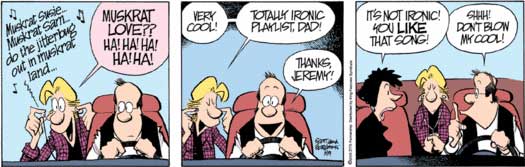
The Carpenters, was driven to anorexia by the words a reviewer who called her "Richard's chubby sister." The theological mis-step I made wasn't spotted by many, but those who did know their stuff. What was the blunder? I told the congregation that The Carpenters recorded Muskrat Love. It was The Captain and Tennille. My bad.

Saturday, July 22, 2006

For My Preacher Friends

With tongue in cheek, Paul Bailey writes: Not every pastor enjoys counseling. [Or, like me, I suspect they feel terribly inadequate - FW] But, other than skipping town, how can you decrease the demand? Here, based on specious clinical research, are a dozen methods guaranteed to keep counseling off your to-do list.
  1. Recite tales of people who are a lot worse off, and call the counselee a cry baby.
  2. Engage the counselor's mother-in-law as a co-therapist.
  3. Don't put a door on your office.
  4. Sing songs such as "Put On a Happy Face" and "Don't Worry; Be Happy" to counselees.
  5. Step out of the office and start laughing uproariously.
  6. Tell the counselee that although you can't figure out a solution to the problem, you'll bring it up in the sermon on Sunday and see if anybody has any ideas.
  7. Casually catch up on your reading while counselees bare their deepest problems.
  8. Tell the counselee you are videotaping the session for replay on the local cable program "Candid Clergy."
  9. Put a bumper sticker on your car: I'D RATHER NOT BE COUNSELING.
  10. Refer them to a helpful article in your favorite professional journal: the National Enquirer.
  11. Suggest counseling by fax machine.
  12. In front of the counselee, phone your spouse and ask for his or her opinion on what to do.

Wednesday, July 19, 2006

Church Camp

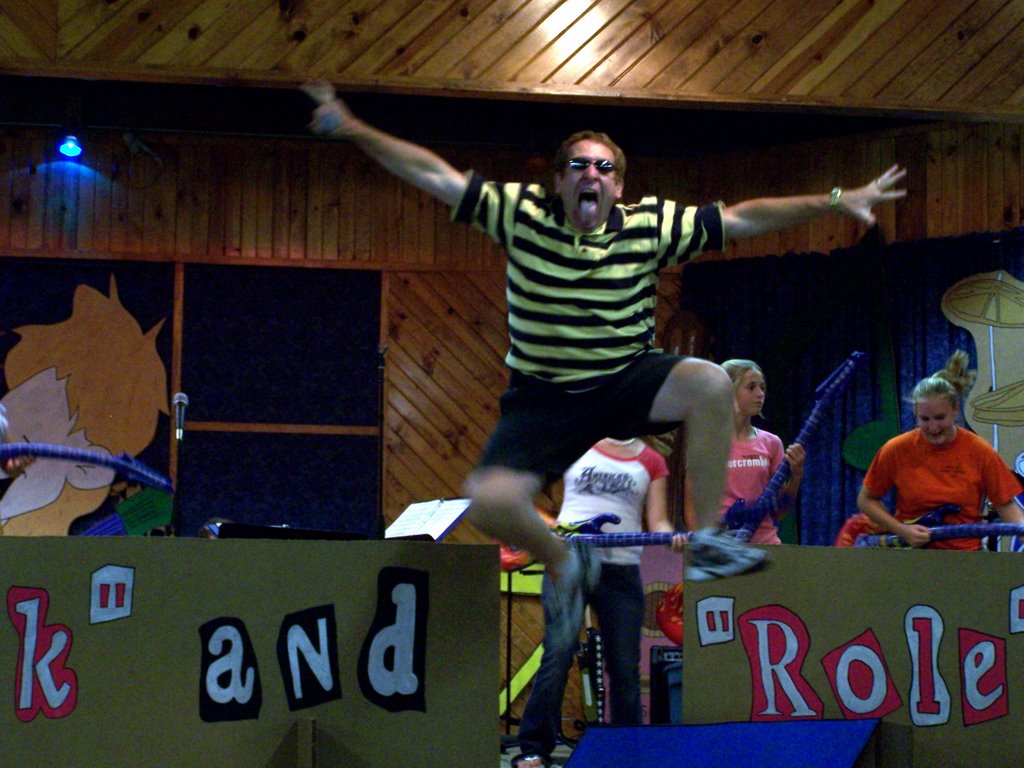
Enjoying the week at Lake James Christian Assembly. Here is a shot from tonight's "talent show" where Frank and the BCC crew air banded Audio Adrenaline's "Never Gonna Be as Big as Jesus."

Friday, July 14, 2006

The price of gold futures took a tumble today . . .

It seems Mr. T has divested himself of his gold chains to help the victims of Hurricane Katrina. Good for you, T. Why now? Why not after, say 9/11. Or why not after Oklahoma City. Why not after the great Christmas Tsunami of 2005?

Call me cynical, but is it possible that this revelation is connected to Mr. T's new television show set to debut in October?

Zizou 'Da Man

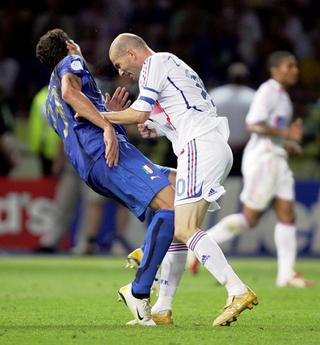
The Boston Globe is condemning the actions of French soccer star Zinadine Zidane for head butting Italian Marco Materazzi during last week's World Cup final. What a bunch of panty-waists. Hello Boston sportswriters. . . have you ever been to a Bruins game? Author Frank Dell'Apa opines that insults and harsh words are part of sports and Zidane should have ignored it. So is fighting. The Bruins have dropped the gloves plenty of times. So have the Celtics. Even the erstwhile, blueblood Bosox have dusted it up a time or two.

Soccer's stock went up in my portfolio last week with the head butt heard 'round the world. (The only direction is could go, by the way.) For me, this sport has been been reminiscent of Zuzu's petals. That image has been replaced by Zizou's pounding.

I know, I know, it was "too violent." It was "unsportsmanlike." But the dude called his mother and sister whores. And he retaliated. Where I come from that is called justice. Part of the world - the part that sings "I'd like to teach the world to sing . . . " - may condemn Zidane, but I'm holding him up to my boys as a man who defended the honor of the women in his life.

Am I wrong in this?

Thursday, July 13, 2006

"Jane" Has Left the Building

My friend, "Joe", was telling me about a disgruntled woman who recently left his church. (Aside - if there is disgruntled, is there such a thing as gruntled?) "Jane" has been critical of Joe from the time he arrived. The music isn't right. The drums are too loud. Her husband should have been asked to chair a committee. On and on.

When asked by one of the church elders why she was leaving to attend a church in another nearby town (the preaching there isn't any better, by the way), she told him, "I'm not getting anything from Joe's sermons. They just aren't deep enough." This mature elder responded with one of the best answers I think I've ever heard. "Jane, I would hope they're not deep enough for you. You've been a Christian for nearly sixty years. I would hope that, by now, you're mature enough that Joe's preaching isn't nearly deep enough. If its deep enough for you, then he's over the heads of all the new believers we're seeing in our church right now."

God bless that elder and God bless Joe. And while He's at it, God bless Jane and her new preacher. He's gonna need it.

Wednesday, July 12, 2006

Trust God Tags

The Indiana BMV recently announced a new "In God We Trust" license plate option for motorists. At no additional cost, Hoosiers can purchase a faith-based plate. Click here to see the four options and to vote for your favorite. Of course, if you purchase these tags, you won't be able to speed, gesture profanely or honk your horn at the curb-hugger ahead of you without looking like a total hypocrite. That's why I got rid of my fish bumper-sticker, after all.

Tuesday, July 11, 2006

Funerals for the Faithless

Most preachers I know say they would rather preside over ten funerals than one wedding. Brides-to-be and mothers of brides-to-be make most weddings miserable for a pastor. The exception to that rule is the funeral of an unbeliever. Few exercises are more difficult for a minister than dancing around the reality of a pagan grandfather's final resting place. The pastor wants to give comfort to a grieving family while the prophet wants to warn those left behind to change their ways before their fate is similarly sealed.

I attended one such funeral yesterday. The preacher did an admirable job. His opening line was "_______ loved nature. _______ loved people." What a tragedy. God forbid that someone could ever say of me, "Frank loved nature, and Frank loved people," without being able to say, "Frank loved Jesus."

You can love nature all you want. You can be everyone's friend of years and friend of tears. But, if you don't love Jesus, death is no welcome friend.

I desperately hope that, sometime during our recently departed friend's brief illness, he was able to connect with Christ in a redemptive way. I don't know if he did; I guess I won't know until I meet Jesus face to face. I do know this: I'm not going to wait. I'm pleading the blood of Christ today and everyday. I count on Jesus' mercy and grace to forgive my sin.

When some pastor (perhaps my son) sermonizes on my burial day, it will be the easiest funeral he has ever preached. "Frank loved Jesus; he loved his family; Frank is in Heaven. Now let's go back to the church and eat ham and scalloped potatoes."

Wednesday, June 28, 2006

More Thoughts From Louisville

Dave Stone drove home the unity point once again tonight at the North American Christian Convention. He suggested that we don't have to be aligned on every point of doctrine in order to find ways to serve together. The single mother who is in desperate need of a house isn't nearly as concerned about my doctrine lining up with my brothers as she is about the two by fours of her new home lining up with each other.

One quote that Stone said stuck with me: My experience is that God never blesses animosity." For all you BCC folks, please refer to yesterday's posting. Are we harboring any bitterness in our hearts? If so, how can we expect God to bless our efforts?

Tuesday, June 27, 2006

Lessons From Louisville

Tis the season for church conventions, and I’m attending one of ‘em. Having just returned from the opening session of the North American Christian Convention in Louisville, Kentucky, I sit in the Galt House Hotel pondering what I’ve just witnessed. Historic is not nearly a descriptive enough term.

Tonight David Faust, the President of this year’s convention, detailed a tragedy that took place in 1906. 100 years ago, beneath the seemingly calm surface of San Francisco, a sudden shift took place in the earth’s tectonic plates. The resulting earthquake measured 8.3 on the Richter scale and tore the city apart. Far more destructive than the quake, however, were the fires that raged through the city in its aftermath.

1906 saw another tragedy: the division of the Christian Church. Fault lines had been forming for decades, but it wasn’t until that fateful year that the split was formalized. In the 100 years since, there have been other schisms, other conflicts. Generations have come and gone, many without even realizing they have Christian siblings they’ve never met. Like the Hatfields and the McCoys, the original combatants have all died, and their great-great grandchildren don’t have an inkling as to what the original fight was even about.

Tonight was the beginning of what will, hopefully, be the end of that division. Thousands of believers from the churches of Christ and the Christian Churches met together for an amazing worship service. It was a wonderful beginning to what promises to be an inspired week.

As I mentioned, this isn’t the only church convention taking place. Last week the Episcopal Church in the United States met. On the agenda: the controversy surrounding the decision to ordain practicing homosexuals and lesbians as Bishops within that fellowship. The week before, the Presbyterian Church (USA) met. They voted to receive a policy paper on inclusive language in worship. If the paper becomes policy, Presbyterians might alternately begin referring to the Trinity as “Mother, Child and Womb.”

The convention I attended tonight had none of that. I am so pleased that our church doesn’t vote on doctrine, but rather expounds it. I am so glad that, when I attend the NACC, we’re not haggling over changes to a Book of Discipline, but rather preaching and teaching from the Books of the Bible.

Oh, we’re far from perfect as a church. Tonight’s message on unity drove that home. We don’t even have unity in our little town of Butler. We’ve got two Christian Churches with 100 feet of one another, and they’ve yet to hold a worship service together. We sing the same songs, share the same heritage, and serve the same Savior, but for some reason we’ve yet to share a loaf of bread and a cup of juice. We send our kids to the same church camp, support the same missionaries, and evangelize the same lost people. We reach across oceans to share the gospel with a pagan, but we won’t reach across Main Street to share communion with a brother.

It is time for that to change.

This year marks the 100th anniversary of the split in the Christian Church / churches of Christ. It has taken 100 years for us to come back together. Next year marks the 10th anniversary of the split between Butler Church of Christ and Christ’s Church at Butler. Will it take ninety more before our great-great grandchildren do what we have not yet summoned the courage to do?

I hope not.

Thursday, June 22, 2006

AOL Hell

Check out this post. This poor sap is trying to cancel his AOL account and runs into the "customer service rep" from hell.